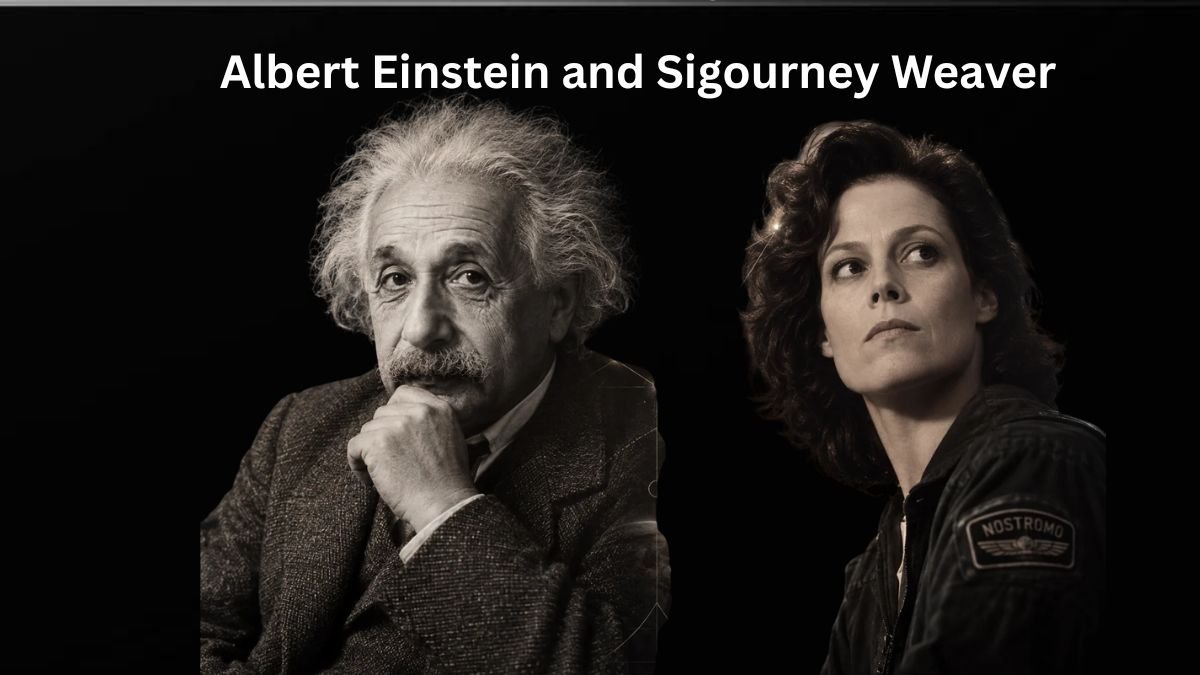
Albert Einstein and Sigourney Weaver belong to completely different areas of modern history. Einstein became one of the most influential scientists of the 20th century, while Weaver built an acclaimed career as an actress known for memorable roles in science fiction, drama, comedy, and action films. At first glance, there seems to be little connection between the two.
Yet the keyword “Albert Einstein and Sigourney Weaver” brings together two fascinating public figures who became cultural icons in very different ways. Einstein changed how people understood space, time, gravity, and the universe. Weaver, meanwhile, helped redefine the image of women in science fiction and became closely associated with some of cinema’s most recognizable characters.
There is no well-established personal relationship between Einstein and Weaver. Einstein died in 1955, before Weaver began her professional acting career. However, exploring both names together offers an interesting look at how science and popular culture have influenced one another.
Who Was Albert Einstein?
Albert Einstein was born on March 14, 1879, in Ulm, in the German Empire. He later became one of the most famous scientists in history. His name became closely connected with the theory of relativity, although his scientific contributions went far beyond one theory.
Einstein’s work changed scientific thinking about space, time, motion, and gravity. His special theory of relativity was published in 1905, a year often described as his “miracle year” because he produced several important scientific papers. His famous equation, E = mc², became one of the most recognizable mathematical expressions in popular culture.
Einstein later developed general relativity, presenting a new understanding of gravity. Instead of viewing gravity simply as a conventional force, the theory described gravity through the curvature of spacetime. His ideas eventually became fundamental to modern physics and continue to influence scientific research.
Einstein’s Influence on Popular Culture
Einstein was not only important to scientists. His distinctive appearance, especially his wild hair and mustache, became part of his public image. Over time, photographs of Einstein appeared in newspapers, magazines, books, advertisements, documentaries, and films.
His name also became shorthand for exceptional intelligence. The word “Einstein” is frequently used in everyday language to describe someone who is considered extremely intelligent. This cultural image sometimes simplifies his real scientific achievements, but it demonstrates how deeply his reputation entered popular culture.
Einstein also became known for expressing views on education, peace, politics, philosophy, and society. His public statements made him a recognizable intellectual figure beyond academic science.
Because of this broad cultural influence, Einstein remains a familiar figure even to people who have never studied physics in detail.
Who Is Sigourney Weaver?
Sigourney Weaver is an American actress whose career spans film, television, and theater. She was born Susan Alexandra Weaver on October 8, 1949, in New York City. She later adopted the professional name Sigourney Weaver.
Weaver became internationally famous through her work in the “Alien” franchise. Her portrayal of Ellen Ripley turned her into one of the most recognizable performers in science fiction cinema. Ripley was presented as capable, determined, and resourceful, making the character especially influential in the development of female action heroes.
Her career, however, has never been limited to science fiction. Weaver has appeared in dramas, comedies, thrillers, and other genres. Films such as “Ghostbusters,” “Gorillas in the Mist,” “Working Girl,” and “Avatar” helped demonstrate her versatility as a performer.
Her long career has made her one of the most recognizable actresses associated with science fiction while also establishing her reputation as a respected mainstream performer.
Sigourney Weaver and the Science Fiction Connection
The connection between Sigourney Weaver and scientific ideas is largely cultural rather than personal. Her most famous character, Ellen Ripley, exists in a fictional universe built around space travel, advanced technology, artificial intelligence, biology, and extraterrestrial life.
The “Alien” films use scientific concepts as part of their storytelling. Spaceships, laboratories, computers, medical equipment, and futuristic technology all contribute to the atmosphere of the franchise. Weaver’s performance places a human character at the center of this technological environment.
This is one reason discussions about Weaver sometimes overlap with discussions about famous scientists such as Einstein. Both names can appear in conversations about science and popular culture, even though their professional fields were fundamentally different.
Was There a Connection Between Einstein and Weaver?
There is no known significant personal connection between Albert Einstein and Sigourney Weaver. Their lives overlapped for only a few years. Einstein died in April 1955, while Weaver was born in October 1949.
This means Weaver was a young child during the final years of Einstein’s life. She had not yet entered the entertainment industry, and Einstein was already an internationally recognized scientific figure.
Any direct connection between the two should therefore be treated carefully. Their relationship is primarily one of cultural association rather than documented collaboration, friendship, or professional interaction.
Einstein’s Ideas and the World of Science Fiction
Einstein’s theories have had an enormous influence on the way writers and filmmakers imagine the universe. Concepts involving time, space, gravity, and the speed of light frequently appear in science fiction.
Popular films do not always portray these ideas with complete scientific accuracy. Fiction often modifies scientific concepts to serve the needs of a story. Still, the broader fascination with space and time owes much to the scientific revolution associated with figures such as Einstein.
Einstein himself did not create modern science fiction, but his work contributed to a scientific worldview that inspired generations of writers, filmmakers, and artists. Questions about the nature of time and the structure of the universe became increasingly important parts of popular storytelling.
Sigourney Weaver’s Role in Modern Science Fiction
Sigourney Weaver’s contribution to science fiction is primarily artistic. Through Ellen Ripley, she helped establish a character who was neither defined solely by romance nor presented simply as a supporting figure.
Ripley became a central protagonist whose survival depended on intelligence, determination, courage, and practical decision-making. This approach helped make the character memorable across multiple “Alien” films.
Weaver’s performance also demonstrated that science fiction could support complex character-driven storytelling. The genre was not simply about futuristic technology or strange creatures. It could explore fear, isolation, corporate power, survival, motherhood, and human relationships.
From Scientific Discovery to Movie Storytelling
One interesting way to understand the Einstein-Weaver comparison is to look at how ideas travel from science into entertainment. Scientists investigate questions about the natural world, while filmmakers transform concepts and possibilities into stories.
Einstein’s work deals with fundamental questions about reality. His theories describe physical relationships that can be expressed mathematically and tested through scientific observation. Cinema works differently. It uses images, performances, sound, dialogue, and narrative to create an emotional experience.
Sigourney Weaver represents the storytelling side of that relationship. Her most famous work placed human characters inside futuristic environments where scientific and technological ideas became part of dramatic conflicts.
The two worlds are different, but they often meet through science fiction.
Why People Search for Albert Einstein and Sigourney Weaver Together
The phrase “Albert Einstein and Sigourney Weaver” can attract attention because both names are strongly associated with intelligence, science, and popular culture, although in different contexts.
Einstein represents real scientific achievement. Weaver represents fictional and cinematic encounters with science and technology. Their names therefore create an unusual combination that can lead readers to wonder whether there is a hidden connection.
Search behavior can also bring together unrelated public figures because of articles, social media discussions, trivia pages, entertainment content, or automated recommendations. A shared search phrase does not necessarily mean that two people knew each other or worked together.
Understanding that distinction is important when researching celebrity and historical figures online.
Einstein’s Legacy in the Modern World
More than a century after some of his most important scientific publications, Einstein remains one of the most recognizable scientists in history. His theories continue to play a role in modern physics.
The practical world has also benefited from technologies and scientific systems that rely on principles connected to relativity. For example, precise timing systems used by satellite navigation need to account for relativistic effects.
Beyond technology, Einstein’s name continues to appear in education, documentaries, books, museums, films, and popular science programs. His life has become a familiar story about curiosity, unconventional thinking, and scientific discovery.
His legacy is therefore both scientific and cultural.
Sigourney Weaver’s Lasting Legacy
Sigourney Weaver’s influence is equally visible within the entertainment industry. Ellen Ripley remains an important character in science fiction, and the “Alien” franchise continues to attract audiences decades after the original film was released.
Weaver’s career also demonstrates how an actor can become strongly associated with one genre without being limited to it. Her performances in comedy, drama, and other forms of cinema expanded her professional identity.
Her work has influenced discussions about women in action cinema and science fiction. Ripley in particular remains a frequent subject of analysis because of the character’s strength, vulnerability, and development across the franchise.
Two Different Kinds of Cultural Icons
Albert Einstein and Sigourney Weaver became famous through entirely different paths. Einstein earned worldwide recognition through scientific research, while Weaver achieved fame through acting and storytelling.
Einstein’s public image became a symbol of intellectual achievement. Weaver’s image became associated with memorable performances and strong cinematic characters.
The comparison is interesting precisely because the two figures are not direct counterparts. One represents the discovery and explanation of natural phenomena, while the other represents the creative interpretation of futuristic ideas through film.
Both, however, demonstrate how individual figures can become larger cultural symbols.
The Broader Relationship Between Science and Cinema
Science and cinema have influenced each other for generations. Scientific discoveries provide filmmakers with new concepts, while movies can shape the public’s understanding of science.
Science fiction often takes real scientific ideas and asks imaginative questions. What happens if humans travel farther into space? Could artificial intelligence become independent? How would people survive on another planet? What might happen if technology develops beyond human control?
These questions are not always predictions. Often, they are storytelling devices designed to explore human behavior.
That is where the worlds represented by Einstein and Weaver indirectly meet. Einstein helped expand humanity’s understanding of the physical universe, while Weaver became one of the performers who brought fictional visions of that universe to life on screen.
Final Thoughts on Albert Einstein and Sigourney Weaver
Albert Einstein and Sigourney Weaver were never professional partners, and there is no major documented personal relationship between them. Their connection is better understood through the broader relationship between science, imagination, and popular culture.
Einstein changed modern physics through groundbreaking work on relativity and other scientific subjects. His name eventually became a global symbol of intelligence and scientific discovery.
Weaver, meanwhile, became an influential figure in cinema, particularly through her portrayal of Ellen Ripley in the “Alien” series. Her work helped establish a memorable model for female protagonists in science fiction and action films.
Looking at the two together reveals an interesting cultural contrast. Einstein represents the real-world pursuit of understanding the universe, while Weaver represents the imaginative stories that explore what humanity might encounter within it. Their careers belong to different worlds, but both continue to shape how people think about science, space, technology, and the possibilities of the future.